How to Build a Target Account List Worth Working
In this article
Knowing your ideal customer and having a list of real people to reach are two different things. One is a description. The other is names, companies, and a reason to start with this account instead of that one. Most outbound stalls in the gap between them. You know who your buyer is in theory, but when it is time to actually send, you are staring at a blank sheet wondering where to begin.
This guide closes that gap. It assumes you have already done the work of defining your ICP, the sharp description of who gets the most value from you. If you have not, do that first, because everything here is just the act of translating that description into a list you can work. Here is how to build one that is worth the effort, step by step.
Start from your ICP, not from a database
The most common mistake is backwards. People open a big database, apply a couple of filters, export ten thousand contacts, and call it a target list. What they actually built is a pile. A target account list is not "everyone who matches a job title." It is the specific set of companies and people your ICP points to, chosen on purpose.
So the list is a translation, not a download. Every account on it should be there because it matches the profile you already decided is your best buyer. If you find yourself adding accounts that do not really fit, just to make the list bigger, stop. A short list of right accounts beats a long list of maybes every time, and you will feel the difference the moment you start writing messages, because the right accounts are the ones you can actually write something true to.
Step one: turn your ICP into search criteria
Your ICP is a description. To find accounts, you need to convert it into things you can actually filter on.
Take the firmographics first. Company size becomes a headcount range. Industry becomes a set of categories. Stage becomes seed, Series A, and so on. Geography becomes regions or markets. Write these down as concrete filters, not vague ideas. "Mid-sized companies" is not searchable. "Software companies, fifty to two hundred people, in North America" is.
Then add the situational part of your ICP, the trigger that tends to come before someone buys from you. That one is usually not a simple filter, but naming it now tells you what to look for in the next steps. If your best customers tend to buy right after they start scaling a team, then hiring activity is a thing you will hunt for. Hold that thought.
Step two: find the accounts
Now you go looking for companies that match. Do not rely on a single source, because each one is blind to what the others see. The strongest lists come from layering a few.
Search by criteria. Use the firmographic filters you just wrote to pull companies that fit the basic shape. LinkedIn search and similar tools get you the bulk of the raw list here.
Look at who resembles your best customers. Your happiest customers are a template. Companies that look like them, in size, model, and situation, are strong candidates. Lookalikes of your winners convert better than cold guesses.
Watch the people around your competitors. Companies engaging with competitors, following them, or commenting on their posts are in-market by definition. They have the problem and they are shopping.
Follow the triggers. Funding announcements, hiring sprees, leadership changes, and the like surface companies at the exact moment your ICP says they are ready. This is where that situational trigger from step one pays off. A company that just matched your trigger jumps to the front of the line.
Pull from several of these and you get a list that is both broad enough to matter and grounded in real fit.
Step three: find the right person at each account
A company cannot reply to you. A person can. So for every account, you need the specific human who matches the champion in your ICP, the role that feels the pain and would push to buy.
Resist the urge to just grab whoever has the most senior title. The highest title is not always the buyer, and a cold message to a busy executive who does not own the problem goes nowhere. Look for the person whose job is most directly tied to the thing you fix. Sometimes that is a director, not a VP. Sometimes there are two people worth knowing, the one who feels the pain and the one who signs off, and you may reach both over time. For now, find the one person at each account who is most likely to care, and note them.
Step four: qualify before you add
A name matching a filter is not the same as a good account. Before something earns a place on your working list, run a quick gut check, because a few seconds of qualifying now saves you from wasting messages later.
Look at the account for the obvious disqualifiers. Are they actually in your market, or did the filter catch a near miss? Do they already look like a customer of a competitor in a way that means they just signed and will not move for a year? Are they so far outside your ICP on something that matters that no message would land? You are not researching deeply here. You are spotting the clear no's and cutting them fast. Disqualifying ruthlessly is what keeps the list clean enough to trust.
Step five: prioritize into tiers
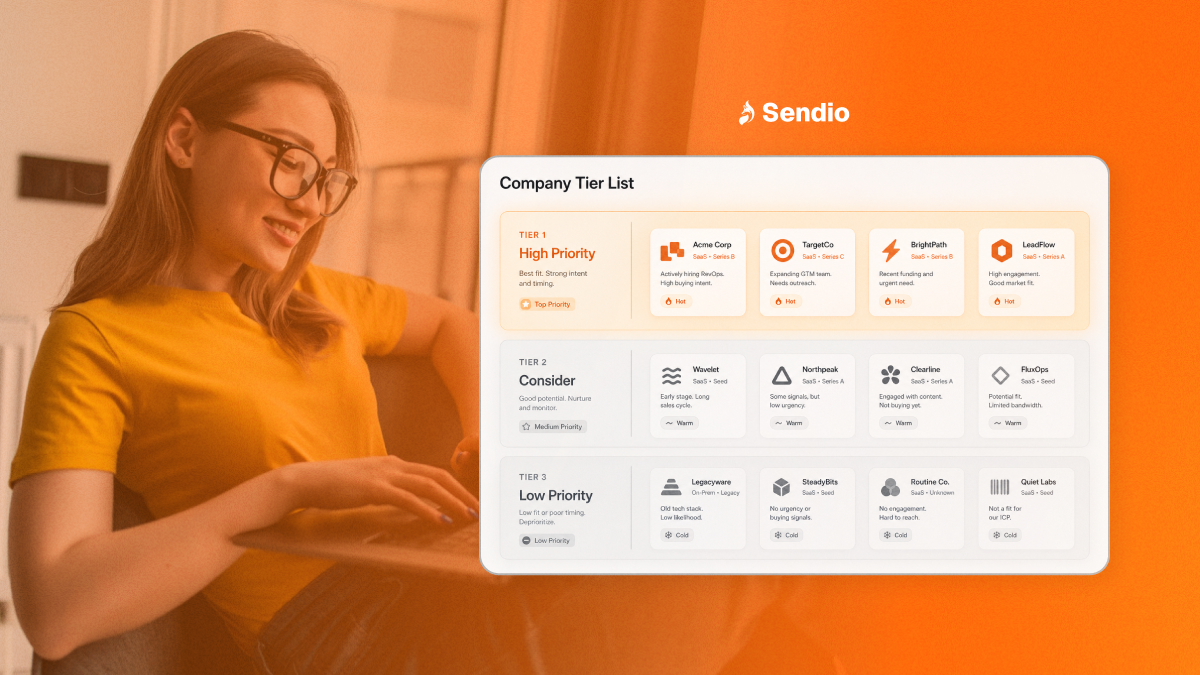
Not every good account is equally good, and treating them all the same wastes your best energy on average fits. So rank them. A simple three-tier system is plenty.
Tier A is the strongest fit plus a live signal. These match your ICP closely and something just changed that says the timing is right. Start here, today, with your most personal effort.
Tier B is a strong fit with no active signal yet. Great accounts, just no urgency right now. These are worth reaching, and they are also worth watching, because a Tier B becomes a Tier A the moment a trigger fires.
Tier C is a reasonable fit you are less sure about. Keep them on the list, but they get your attention after the better tiers, and they are the first to go if the list gets too big.
The point of tiering is sequence. You work A before B before C, so the accounts most likely to convert get reached first and fastest.
Step six: know when to stop adding
There is a strong pull to keep growing the list forever, as if more names equal more pipeline. They do not. Past a certain point, a bigger list just means you do shallower work on each account, which is the opposite of what makes outbound convert.
A good target list is one you can actually work well. If you cannot write something specific and true to every account on it, it is too big. It is better to deeply work a focused list and expand once you are winning than to spread yourself thin across thousands you will only ever spam. Stop adding when the list matches your capacity to do real outreach, not when you run out of names.
Keep the list alive
The last thing to understand is that a target list is not a one-time export. It is a living thing. Accounts change. New companies hit your trigger every week and deserve to be added. Old accounts go cold, get acquired, or sign with someone else and should come off. A Tier B lights up with a signal and graduates to Tier A. If you build a list once and never touch it again, it slowly drifts out of date and out of fit.
The teams that do this well treat the list as something they tend, not something they finish. New triggers in, dead accounts out, tiers updated as situations change.
Common mistakes to avoid
A few traps catch almost everyone. Buying a giant generic list and treating it as targeted, when it is just volume with a label. Adding anyone who matches a job title without checking fit. Skipping the qualifying step and letting bad accounts pollute the list. Reaching the most senior person instead of the right person. And treating the list as finished the day you build it, then wondering months later why it stopped working.
Avoid those and you will have something most people never build: a list where every account belongs there, ranked so you know exactly who to reach first, and current enough to trust.
That last part, keeping it current as triggers fire, is the piece that takes real work to do by hand. It is also where Sendio helps. You define the profile and the accounts that matter, and it watches for the buying moments across exactly those companies, so your Tier B graduates to Tier A on its own and the right message goes out while the timing is fresh. The list you built stays alive without you babysitting it.
Build from your ICP, find accounts from more than one source, reach the right person, qualify hard, tier by fit and timing, and keep it alive. Do that and your outreach finally has a foundation worth standing on.