Rewriting a Cold Message Line by Line
In this article
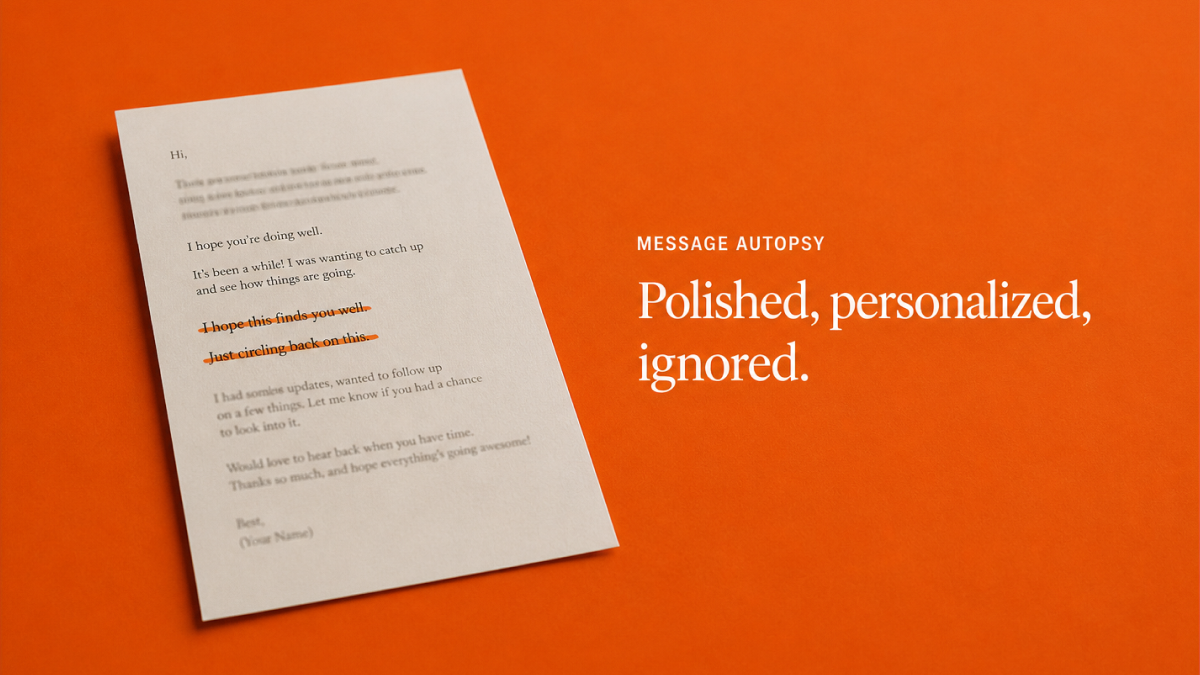
Here is a message shaped like ten thousand others. It is polite, grammatical, personalized, and it will be ignored.
Hi Marcus, hope you're doing well! I came across your profile and was really impressed by your background in sales leadership. At Acme we help B2B companies scale their outbound with AI powered automation that saves hours every week. Would love to hop on a quick 30 minute call to show you a demo and explore synergies. Let me know what works for your calendar!
Nothing in it is a mistake exactly. That is what makes it worth taking apart.
"Hope you're doing well"
Zero information. It costs the reader a second and tells them the next sentences were written by someone with nothing specific to say. Every automated message in their inbox opens this way, so it functions as a label.
Delete it. There is no replacement.
"I came across your profile and was really impressed"
This is the compliment that is not one. Impressed by what, exactly. The sentence works identically for any of four hundred people, which the reader knows, because they have received it from four hundred people.
A compliment that could be copied to a stranger is not personalization. It is an admission that you had no reason to write beyond their title matching a filter.
"At Acme we help B2B companies scale their outbound"
Here is where the message becomes about the sender. Three clauses in and we have moved from a fake observation about them to a generic description of you.
Notice also what is missing: any statement about their situation. A buyer reads this and has to do the translation work themselves, deciding whether this vague category of help applies to the thing on their desk this week. Most will not bother.
"AI powered automation that saves hours every week"
An unverifiable claim with no number attached, in a category where every competitor says the identical sentence. It asks for trust before giving any reason to extend it.
If you have a real number, use it. If you do not, describe the mechanism instead, because a specific mechanism is believable in a way that a vague benefit never is.
"A quick 30 minute call to show you a demo and explore synergies"
Three problems in one line. Thirty minutes is not quick, and calling it quick tells the reader you are willing to shade things. A demo is what you want, not what they need at this stage. And "explore synergies" is a phrase that has never once appeared in a message that got answered.
The ask is also simply too big. You are a stranger requesting half an hour from someone who has no evidence yet that the half hour would be useful.
"Let me know what works for your calendar"
The closing hands the reader a task with no boundaries. Scan your week, pick something, propose it, own the decision. Plenty of mildly interested people stop right here, not from resistance but from friction.
The rewrite most people do
Now watch the usual fix, which is to make it prettier.
Hi Marcus, saw you've been at Acme for 5 years leading a team of 12 in the SaaS space. Quick question for you: most VPs of Sales in B2B SaaS tell me pipeline predictability is their #1 challenge. Is that true for you too? We help teams like yours fix it. Open to a chat?
Better written. Shorter. It has real variables pulled from a profile. It will still fail, and the reason matters more than any of the line edits above.
Nothing happened. There is no event, no date, no reason this message arrives today rather than last March or next October. The details are decoration applied to a message that exists because you decided to send it, not because something changed on their side.
That is the ceiling of personalization without relevance. You can polish a message with nothing behind it until it is beautiful, and it will still read as a stranger who wanted something.
The rewrite that works
Hi Marcus, saw you took over sales at Acme five weeks ago and there are two SDR roles open. The gap between signing a rep and that rep producing pipeline is usually a quarter, and the number you inherited does not wait that long. Worth fifteen minutes on how teams cover that stretch while they hire?
Count what changed structurally.
It opens with an event. A dated fact about them, which is the only thing that explains why this message exists this week.
It names the consequence, not the product. The problem is described in terms of their calendar and their number. The product never appears.
The claim is a mechanism. The quarter long ramp between hire and pipeline is checkable and specific, so it does not require trust to accept.
The ask fits the relationship. Fifteen minutes to compare notes is a decision a stranger can make. Thirty minutes for a demo is not.
It has no filler. No greeting, no compliment, no synergies. Four sentences, every one carrying information.
Run this on your own opener
Three questions, in order.
First, delete every sentence that would be true for someone else. What survives is your actual personalization, and for most messages that is nothing.
Second, find the event. If you cannot point at something dated that happened to this company, you do not have a reason to write today, and no amount of rewriting creates one.
Third, read the ask out loud. If a stranger asked you for that, in that wording, would you say yes this week.
Where Sendio handles the hard part
The second question is the one that software can answer and copy editing cannot.
Sendio monitors more than thirty buying signals and only surfaces accounts where something dated actually happened, scored by how recent the signal is, how many overlap, and how well the company matches your ICP. Then it writes the message around that specific signal at the moment of send, using the role and headline the person holds today rather than whatever was true when you built the campaign. The opener names the event because the event is the reason the message exists at all.
You keep the voice and the judgment. The part you stop doing is inventing a reason to write.
Professional is $79 a month, fourteen day free trial, no credit card.
Keep the autopsy habit
Once a month, take your worst performing opener and cut it apart this way, sentence by sentence, asking what each one does for the reader.
Most of the time you will find three lines of filler, one claim nobody can check, and an ask that was too large. Those are easy fixes. The hard one is admitting the message never had an event behind it, which is a targeting problem wearing a copywriting costume.