Signals vs Intent Data: What Actually Works for Outbound
In this article
If you spend any time around B2B sales tools, you hear two phrases that sound like the same thing. Intent data. Buying signals. Both promise to tell you who to reach out to, and both get sold as the way to stop wasting outreach on people who are not ready. They are not the same thing, though, and the difference between them decides whether your outbound actually gets sharper or just gets a new dashboard. Here is what separates them.
The short version. Intent data usually tells you that an account is probably warm on a topic, as a score, aggregated and anonymous. A buying signal tells you that a specific person did a specific thing at a specific time. One is a probability. The other is an event. And an event is something you can actually act on, while a probability mostly just tells you to try.
What intent data actually is
Let us describe intent data fairly, because it is a real category and it is not useless. The traditional model works roughly like this. Networks and vendors track behavior across the web, content people consume, topics companies research, keywords that are surging inside an organization, and they roll it up into a signal that says something like "accounts in this segment are showing elevated interest in your category." You buy access, and you get a list of accounts with an intent score attached.
Used well, that can help you prioritize. At scale, if you have thousands of accounts and limited time, knowing which ones are showing category interest is better than guessing. So intent data has a place, especially for large teams deciding where to point their effort. The problem is not that it is fake. The problem is what it can and cannot tell you.
The trouble with a score
Intent data has a few structural limits that matter a lot for outbound.
It is usually account-level and anonymous. You learn that someone at Acme has been researching your category. You do not learn who, so you still do not know which human to message. You are told the building is warm, not which door to knock on.
It is a probability, not an event. An intent score says "this account is likely interested." Likely, based on aggregated behavior. It is a guess with a number on it, and it can be wrong, and even when it is right it does not tell you why they are interested or what to say.
It is often stale and aggregated. Because it is rolled up over time from many sources, the signal can be weeks old and smeared across a window. By the time it surfaces, the moment may have passed, or it may never have been a moment at all, just background research by one curious employee.
Everyone buys the same data. Intent data is a product sold to many customers, so the accounts flagged as warm for your category are flagged for your competitors too. You are all descending on the same list at the same time, which is its own kind of saturation.
So intent data tells you, vaguely, that a category is warm somewhere inside an account, sometime recently, probably. That is a starting point. It is not a reason to reach out to a specific person today with something specific to say.
What a buying signal is
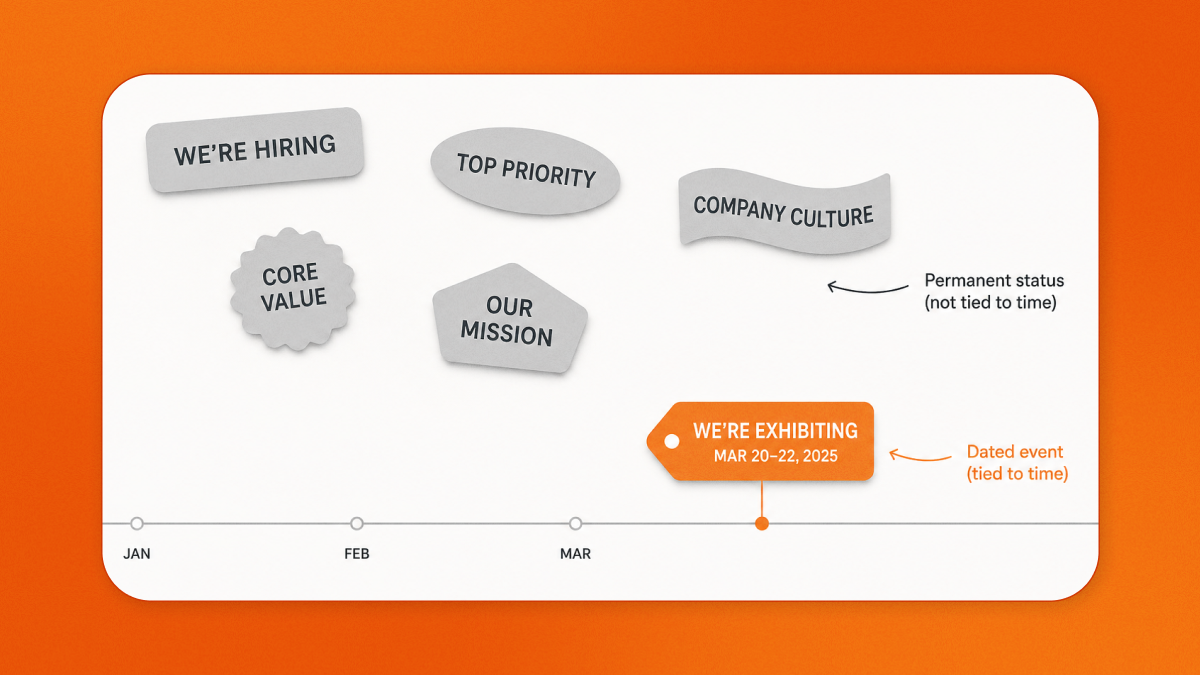
A buying signal is the concrete version of the same idea. It is a specific, usually public event tied to a specific person, at a knowable time. Someone got promoted into the role that owns your problem. A company announced a funding round. A team posted six open sales roles. A company added or dropped a tool in their stack.
Notice what you get with each of those that a score never gives you. You know who, an actual person, not an anonymous account. You know what happened, the exact event. You know when, because the event has a date. And because you know all three, you know what to say, since the message can be built around the event itself. A signal is not a guess that someone might be interested. It is a fact about something that changed, and change is what creates real reasons to buy.
Head to head
| Intent data | Buying signals | |
|---|---|---|
| What it is | A probability score of category interest | A concrete event that just happened |
| Level | Usually account-level and anonymous | Tied to a specific person |
| Timing | Aggregated, often stale | Dated, fresh, actionable now |
| Tells you | That an account is probably warm | Who, what, and when, so you know what to say |
| Exclusivity | Same data sold to everyone | Public events you catch and act on first |
| Best use | Prioritizing accounts at scale | Reaching the right person at the right moment |
Why signals are more actionable
Here is the practical difference in one idea. Intent data tells you to knock on a door. A buying signal tells you why the door just opened, so you know what to say when you walk through it.
That second part is everything, because the hardest part of outbound is not deciding roughly who might care. It is having a specific, true reason to reach out to a person right now that makes your message land instead of getting ignored. A signal hands you that reason. "You just raised a Series B, and teams usually feel pipeline pressure right after." An intent score cannot produce that sentence, because it does not know what happened, only that something, somewhere, maybe did. You cannot write a relevant message from a probability. You can write one from an event.
Where intent data still earns its place
To be fair, this is not a case that intent data is worthless and signals are all you need. For large teams with huge account universes, intent data is a reasonable way to narrow the field, to decide which slice of the market to focus on this quarter. Think of it as a coarse filter. It can tell you where to look. It just cannot tell you what to do when you get there.
The strongest approach uses them in that order. Let broad intent, if you have it, help you choose a territory. Then rely on concrete signals to decide who to actually reach, when, and with what message. Intent data narrows. Signals act. Problems start when people treat an intent score as if it were a reason to reach out, because it is not one, and outreach built on a vague score ends up as generic as any other spray.
What to actually want
Strip it all back and the thing you actually want is not a warmer-looking list. It is concrete moments you can act on. A person, an event, a date, and therefore a reason to say something specific and true. That is what turns targeting into a booked meeting instead of just a better-scored list of names everyone else also bought.
That is the whole idea behind how Sendio works. It is built on buying signals, the concrete events across your market that tell you not just that an account might be warm, but that a specific person just did something that makes your product relevant right now, and it writes the message around that event. Not a probability. A reason. If your outbound has been running on vague warmth, the upgrade is not more data. It is catching the actual moments and acting on them first.