Outbound for a Head of Sales: Building a Motion Your Team Can Run
In this article
title: "Outbound for a Head of Sales: Building a Motion Your Team Can Run"
slug: outbound-for-a-head-of-sales
category: Tutorials
meta_description: "New Head of Sales inheriting a number and a small team? Here's how to build a repeatable outbound motion that scales on relevance and timing, not volume."
cover_image: "A single conductor's stand with a warm orange baton in front of a few music stands, suggesting one leader setting the motion for a small team. Calm, in-command mood. Avoid generic sales-team high-five stock."
Outbound for a Head of Sales: Building a Motion Your Team Can Run
You took the number. Maybe you just stepped into the Head of Sales seat, maybe you have owned it for a while, but either way the job is the same: hit a target with a small team, and outbound is a big part of how you get there. The mistake most new sales leaders make is running outbound the way they did as an individual rep, just louder and across more people. That does not scale, and it burns your team and your accounts doing it. Your job now is different. It is to build a motion the team can run repeatably, and this is how to think about that.
The shift in your head has to come first. As a rep, you won by being good at outreach yourself. As a leader, you win by making a whole team good at it, consistently, without you doing the sending. Your product is now the system and the coaching, not your personal activity. Everything below follows from that.
Do not inherit the old volume playbook
The path of least resistance is to tell the reps to send more. Set higher activity quotas, load bigger lists, push the numbers up. It feels like leadership and it is the fastest way to break your team. Volume stopped being the winning lever, so telling reps to do more of it scales mediocre results, numbs your market, and puts every account you operate at risk. You also train your reps in exactly the habit that will make them worse over time.
A good sales leader resists the volume reflex on behalf of the whole team, because the team will do whatever you measure and reward. If you reward activity, you get spray at scale. Set the foundation on something better before you ask anyone to ramp.
Set the team on a shared foundation
The advantage a team has over a solo operator is consistency, but only if everyone is running the same sharp playbook. That starts with a shared, clearly defined ICP, so every rep is reaching the same kind of right person instead of each one guessing. It means a target account approach, where reps work well-fit accounts on purpose rather than dialing down a random list. And it means reaching people around real timing and signals, not just firing a cadence at everyone on a schedule.
When the whole team shares that foundation, a new rep inherits what works instead of reinventing it, your results get predictable, and you can actually tell what is working because everyone is running the same thing. A team without a shared foundation is just several different experiments wearing the same logo.
Measure what you actually want
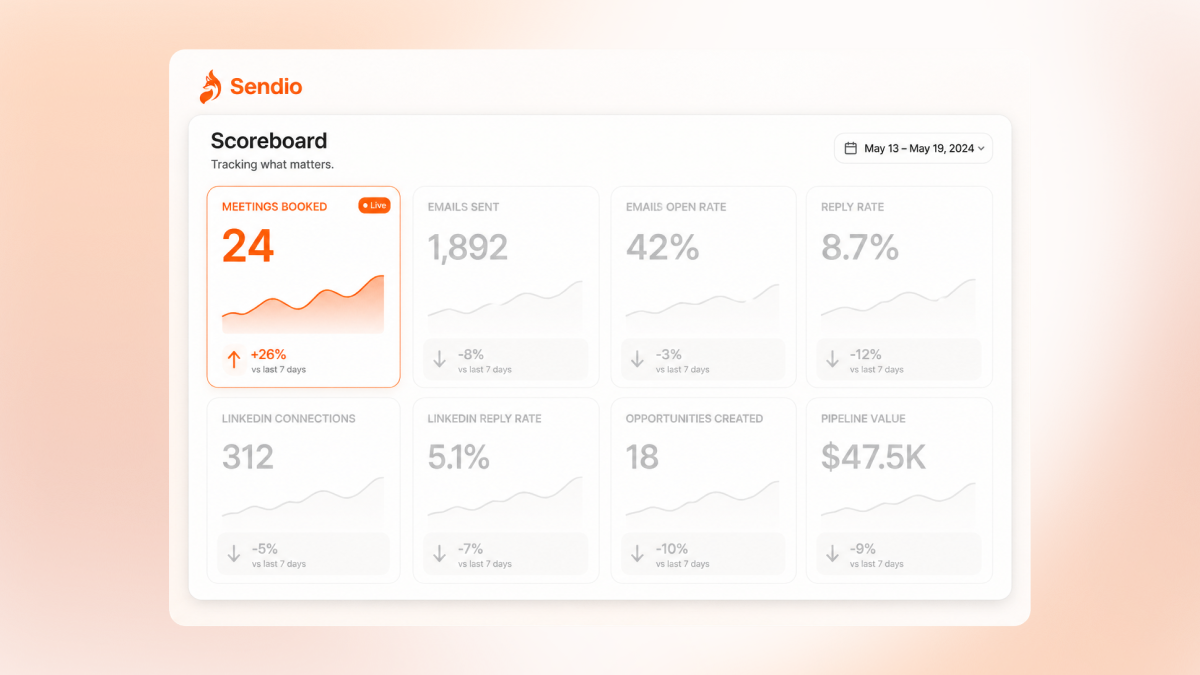
This is the highest-impact thing a sales leader controls, because your team will chase whatever you put on the scoreboard. Put the wrong metric up and you get the wrong behavior, fast. If you measure messages sent and connections made, you get reps who maximize sending and generate spam. If you measure meetings booked and positive reply rate, you get reps who care about reaching the right people well.
So make the scoreboard the outcomes. Meetings booked per rep, and the quality behind them, positive replies, not just any reply. Track activity if you must, but never let it be the headline, because the moment activity becomes the goal, quality quietly dies and your team optimizes for looking busy. What you celebrate in the team meeting is what you will get more of. Celebrate meetings, not motion.
Protect the team's accounts
When one person runs outbound, one account is at risk. When a team runs it, every rep's account is exposed, and each one is a person who goes offline if it gets restricted. So account safety stops being an individual concern and becomes a team-level responsibility that lands on you. That means human-paced sending across the team, healthy acceptance rates, relevant targeting, and cloud-based tooling rather than anything reckless. One avoidable ban is not a metric dip, it is a rep who cannot work until it is sorted. At team scale, safety is part of your operating discipline, not an afterthought.
Ramp new reps without teaching bad habits
New reps arrive wanting to prove themselves, and the fastest way they know to look productive is activity. Left alone, they will crank volume, spray generic messages, and possibly get a fresh account flagged in week one. Your job is to point that energy at relevance from day one, so they build good habits instead of bad ones. Get them warming their account properly, working a sharp list, and reaching people with a real reason, before they ever try to scale. A rep taught relevance first becomes good. A rep taught volume first has to unlearn it later, and most never do.
Coach the conversation, not just the send
Here is where a sales leader adds the most, and it is not in the sending. The sending can be systematized. The money is in what happens after the reply, and that is where reps need coaching. Handling objections without getting defensive or pushy. Turning a warm reply into a booked meeting fast. Running a first call that listens more than it pitches. These are human skills, and coaching them across your team is the part of the job that only you can do. Systematize the mechanical half so your reps spend their real attention on the conversations, then coach the conversations relentlessly. That is where a team's win rate actually moves.
Free the team from busywork so they sell
Reps do not fail because they are lazy. They fail because the day fills up with everything that is not selling, finding accounts, researching, checking for signals, drafting first messages, updating lists. Every hour there is an hour not spent in a conversation that could become pipeline. As the leader, your job is to take that weight off them. The repetitive finding and drafting is exactly the work worth automating, so your reps spend their hours on the human, high-value parts. A team freed from busywork sells more without working more, and that is a multiplier you control.
What a healthy team motion looks like
Put it together and the picture is clear. Every rep works a shared, sharp ICP. They reach well-fit people around real timing, not a blind cadence. Their accounts stay safe because sending is paced and relevant. The scoreboard is meetings and positive replies, so the team chases quality. New reps ramp into good habits. And the repetitive work is handled by tooling, so reps spend their time in conversations, which you coach. That is a motion that scales with people instead of breaking under them.
That is also where a signal-based system fits into a sales team's stack. Sendio watches for the buying moments across your target accounts and drafts the message around each signal, so your reps reach the right people at the right moment without spending their day hunting and writing from scratch. It gives a team the reach and relevance that used to require either heroics or a spray, and it keeps the accounts safe while doing it. You still lead, set the ICP, coach the conversations, own the number. The tool just makes sure the top of your team's funnel is full of the right people at the right time.
Lead the motion, do not just push the volume. Shared ICP, timing over cadence, a scoreboard of meetings, safe accounts, good habits from day one, and your coaching aimed at the conversations. Build that, and you have a team that hits the number without burning out or getting banned to get there.