How to Turn 'Sounds Interesting' Into a Booked Meeting
In this article
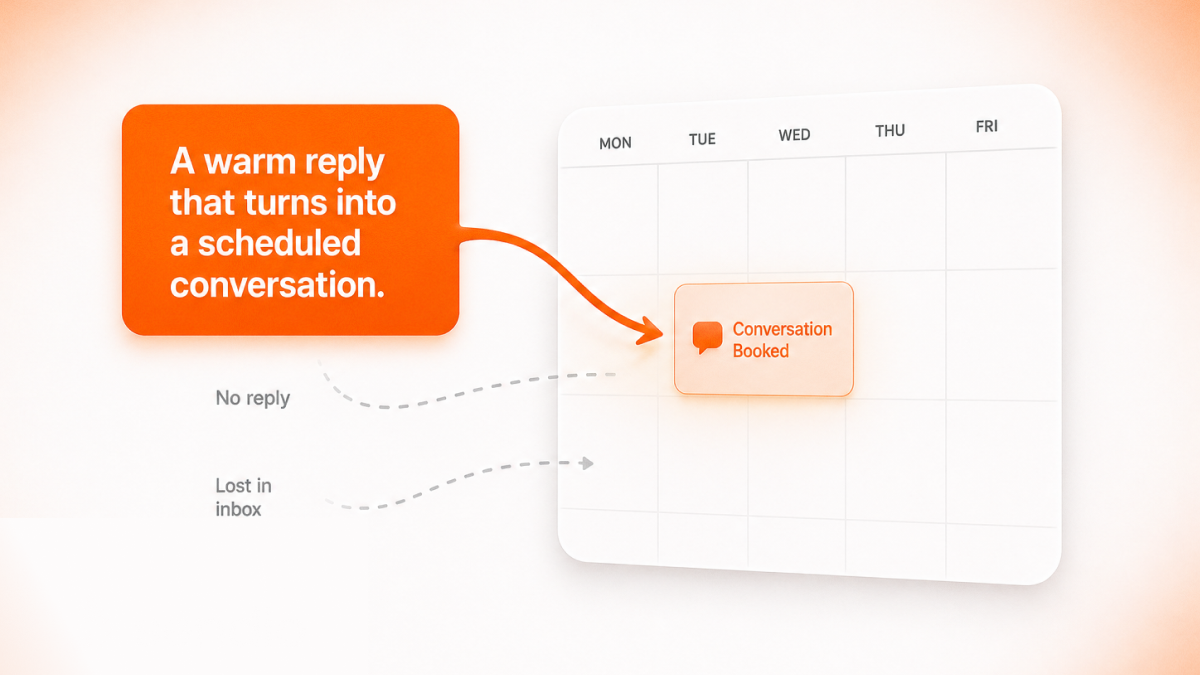
For a while I thought a positive reply was the win. Someone would write back "sounds interesting" or "yeah, tell me more," and I would feel great, like the hard part was done. Then a lot of those conversations just quietly fizzled and never turned into an actual meeting. It took me a while to accept the obvious. The reply is not the win. The meeting is the win. And the space between "sounds interesting" and a time on the calendar is where a shocking amount of pipeline quietly leaks out.
This post is about closing that gap. It is a small skill, and it is one of the highest return things you can get good at, because you already did the hard work of earning the reply. Fumbling the handoff from interest to a booked call is throwing away the most expensive part. Here is how to convert it.
Move fast, because interest decays
The single biggest lever is speed. A positive reply has a short shelf life. The person was interested in the moment they wrote back, and that interest fades fast as they get pulled into their day. Reply an hour later and you are still in the moment with them. Reply two days later and you are reaching a person whose curiosity has cooled and who has half forgotten why they were interested.
So when a warm reply comes in, treat it as the priority it is. You do not need a perfect response, you need a fast, human one. I would rather send a quick, slightly imperfect reply within the hour than a polished one tomorrow. The speed itself signals that you are on it, which makes the person more likely to keep moving with you.
Do not spike the ball
The opposite failure is getting so excited by a yes that you dump everything on them. They said "tell me more," and you reply with six paragraphs, a feature list, three links, and your life story. That kills the momentum you just earned. A positive reply is an open door, not a signed deal. Your job is to walk through it, not to unload your whole pitch in the doorway.
Keep your reply short and warm. Acknowledge what they said, connect it to why a quick conversation makes sense, and move toward a time. That is it. The details belong in the meeting, which is exactly why you want the meeting.
Make the ask specific and easy to say yes to
Here is where most people lose the deal, and I lost plenty this way. They end the reply with something vague. "Let me know when works for you." "Happy to chat whenever." "Feel free to grab time." All of that sounds polite, and all of it quietly hands the work back to the prospect. Now they have to figure out their availability, pick a time, and drive the scheduling, and busy people just do not get around to that.
Lower the effort to almost nothing. Either propose two or three specific times and let them pick one, or send a scheduling link with a clear, warm sentence around it. Both work. What matters is that saying yes takes one click or one word, not a planning session. The easier you make the next step, the more people take it. You are removing friction, not adding manners.
The scheduling link question
People argue about whether to send a booking link or propose times. My take, after doing both a lot, is that it depends on how warm things are. When someone has clearly leaned in and just wants to talk, a scheduling link is friendly and fast, and you should use it. What you should not do is answer a lukewarm reply by dropping a bare link with no human words around it, because that feels cold and transactional and it stalls. If you send a link, wrap it in warmth and a reason. If you sense hesitation, proposing a couple of specific times feels more personal and keeps you in control of the momentum.
Give them a reason for the meeting
A meeting is a cost to the other person, so give them something worth the time. The weak version is "let us hop on a quick demo." A demo is what you want, not what they want. The strong version ties the meeting to the exact thing they said they cared about. If they mentioned a problem, frame the call around that problem. "Happy to show you specifically how teams handle the thing you mentioned about ramping reps, twenty minutes, and you can decide if it is useful."
Now the meeting has a point that belongs to them, not to you. You are not asking for thirty minutes to talk about your product. You are offering twenty minutes to help with the thing they just told you hurts. That is a much easier yes.
Keep the friction low everywhere
Every little bit of effort you ask for is a chance for the deal to stall, so strip it out. Keep the meeting short, fifteen or twenty minutes, not forty five, because a small ask converts better and you can always go longer if it is going well. Be flexible on timing and offer options that fit their world, not just yours. Do not make them download anything or fill out a form to talk to you. The path from "yes" to "on the calendar" should be as close to effortless as you can make it.
Handle the soft yes
Sometimes the reply is interested but dodgy. "Just send me some info and I will take a look." That is usually not a real next step, it is a polite way to slow things down, and if you just send a deck you will likely never hear back. Do not fight it, redirect it gently. Offer to send something short, and in the same breath offer a tiny call as the easier path. Something like, happy to send a one pager, though honestly fifteen minutes would save you reading it, would Thursday or Friday work. You are respecting their ask while steering back toward the thing that actually moves it forward, a real conversation.
The booking is not done until they show
One last piece people skip. Getting the time on the calendar is not the finish line, because no-shows are real, especially from a cold start. Confirm the meeting warmly when it is booked. A short, friendly note the day before helps. If you can, drop in one line of value before the call so they walk in already glad they said yes. A little attention between booking and meeting is the difference between a calendar full of confirmed calls and a calendar full of ghosts.
The common mistakes
Almost every lost warm reply traces back to a few of these. Being slow, so the interest cools before you answer. Ending with a vague "let me know what works" that hands the work back to them. Over-pitching the reply instead of just moving to a time. Asking for a heavy forty five minute demo when a short call would convert. Dropping a bare scheduling link with no warmth. Giving no real reason for the meeting. And letting "send me info" quietly end the conversation. Fix those and your positive replies stop evaporating.
I will connect this to what we do, briefly and honestly. Sendio does the hard part, watching for the buying moment, reaching the right person, and earning that positive reply in the first place. It even brings those replies into one place ranked by intent, so the warm ones are right in front of you while they are still warm. But the move from a warm reply to a booked meeting is yours to make, and it is worth being sharp at, because it is the cheapest pipeline you will ever create. You already paid for the reply. Do not let it die three messages from the finish line.
A reply is a door opening. Move fast, keep it warm, make the ask tiny, give them a reason, and get the time on the calendar while the interest is still hot. Do that and "sounds interesting" turns into a meeting far more often than it does for everyone still saying "let me know what works for you."